
Buying branded workwear: embroidery, DTF or screen printing?
A step-by-step guide to branded workwear: choosing a decoration method, positioning, artwork approval, lead times and the special rules for certified protective clothing.
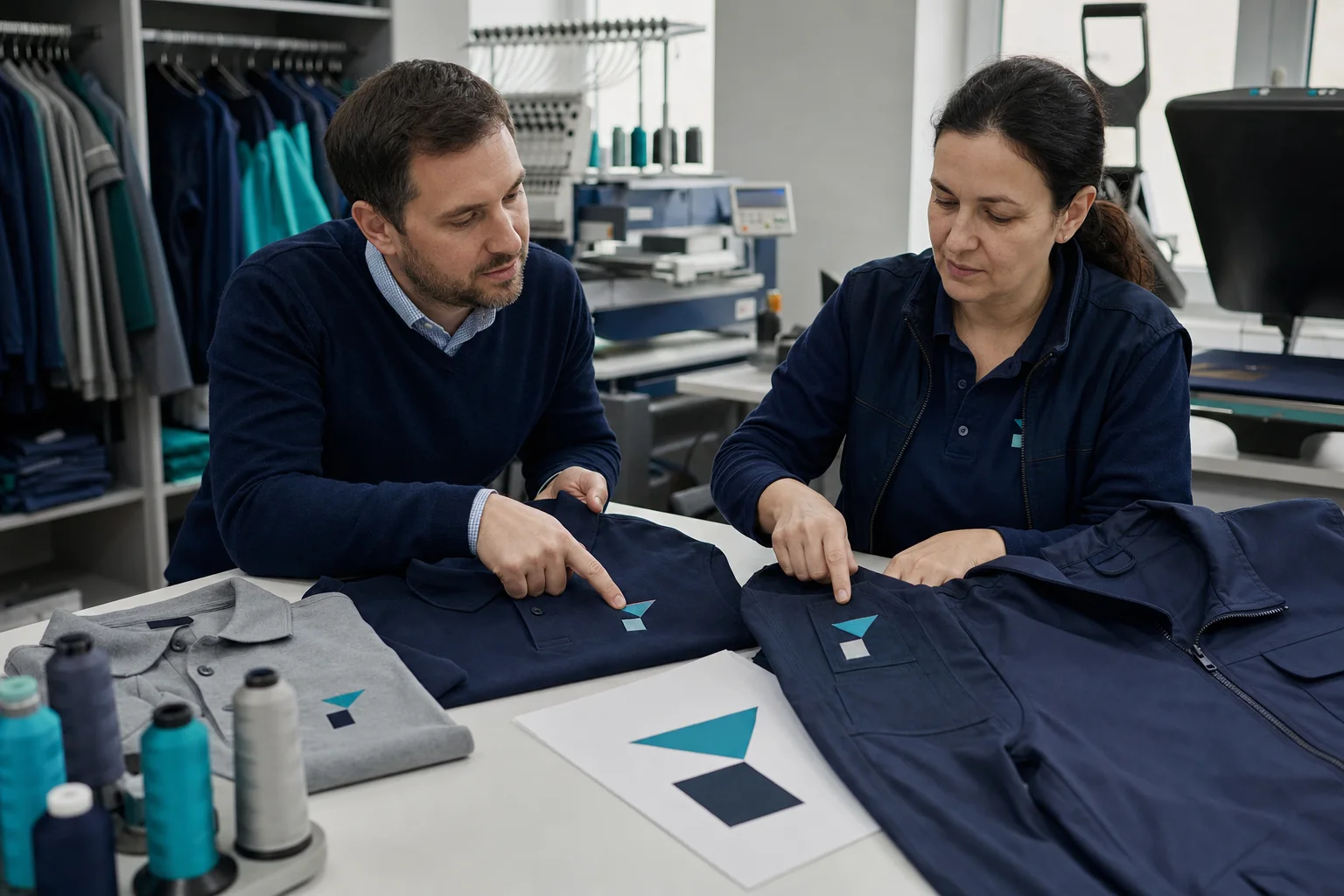
Branded workwear is both equipment and a moving company sign: a consistent team looks professional to customers, is easy to identify on site and gains a stronger sense of belonging. For the buyer, decoration adds another set of decisions — method, position, colour and lead time — plus one technical trap: an unsuitable process can compromise certified protective clothing. This guide follows the order from initial brief to delivered garments.
The essentials in thirty seconds
- The three main methods are embroidery, DTF transfer and screen printing. Quantity, fabric and artwork determine the right choice.
- Decoration on certified protective clothing is a technical decision. Flame-resistant, high-visibility and membrane garments require particular care.
- A controlled process is artwork submission → visual proof for approval → production.
- Lead time combines garment availability and decoration production; do not leave a rebrand until the final week.
- We can brand suitable items across the catalogue range, keeping garment supply and decoration under one point of responsibility.
🎨 Which technique suits which job?
| Technique | Strength | Points to consider | Typical use |
|---|---|---|---|
| Embroidery | Durable, refined and wash resistant | Very small text and gradients reproduce less well; needles penetrate membrane layers | Chest and sleeve logos on polos, sweatshirts and jackets |
| DTF transfer | Detailed, full-colour artwork, economical for small quantities | Applied with heat, so fabric heat tolerance matters | T-shirts, suitable visibility garments and mixed short runs |
| Screen printing | Economical at volume with strong solid colours | Set-up is normally charged per colour; best for simpler artwork | Large T-shirt runs and single-colour back prints |
A useful starting rule is small quantity plus detailed colour artwork → DTF; durability and a premium finish → embroidery; large run plus simple artwork → screen printing. The garment and artwork must still be checked together before a final recommendation.
⚠️ The technical trap: decorating protective clothing
On ordinary workwear, decoration is largely an aesthetic choice. On certified protective clothing, it can affect protective performance:
- High-visibility clothing (EN ISO 20471): a logo must not cover retroreflective bands, and any reduction in visible background area must remain within the garment’s certified design.
- Flame-resistant and multi-standard clothing: decoration materials and processes must be compatible with the claimed protection. An ordinary meltable transfer may introduce an unacceptable hazard.
- Waterproof membrane jackets: embroidery punctures the membrane. Follow garment-maker instructions and select the process accordingly.
This is why decoration and PPE expertise should not be separated. Our recommendation considers the protective garment first, rather than treating it as a blank promotional textile.
🧭 Procurement step by step
- Select the garment: match protection, material and size range to the work before discussing decoration. Suitable items can be selected from the catalogue.
- Provide the artwork: a vector PDF, SVG or AI file is preferable. If only a bitmap is available, flag it so artwork preparation can be assessed.
- Agree method and position: chest, sleeve or back, with finished size and colours. These choices drive much of the cost.
- Approve a visual proof: confirm what will be applied before production. Do not release a job without this step.
- Production and delivery: allow for garment supply and decoration. A new identity or large programme should be planned in weeks rather than days.
Send the logo, headcount and garment types in a quote request. We will recommend a method, prepare a proof and supply the garments and branding as one managed order.
💰 What determines the price?
- Method and colour count: stitch count for embroidery, number of colours for screen printing and printed area for DTF.
- Quantity: each method has preparation costs, so unit cost normally falls with volume.
- Number of positions: chest, back and sleeve are three applications, not one.
- The garment: decoration is added to garment cost. A uniform change affecting the workforce belongs in the annual PPE and workwear budget.
❓ Frequently asked questions
Can you decorate garments supplied by us?
The clearest and fastest route is to decorate garments bought through us, leaving one supplier responsible for garment compatibility and the finished result. Customer-supplied garments are considered individually; include the details in the enquiry.
What is the minimum quantity?
It depends on the method. DTF and embroidery can work for small quantities, while screen printing benefits from scale. We serve both small teams and workforces of several hundred.
Will washing remove the logo?
A correctly specified process should match the garment’s intended care regime. Embroidery is particularly durable; quality DTF and screen printing can last well when fabric, process and wash instructions are aligned.
Can a high-visibility vest carry a large back logo?
Only where the garment retains the area and configuration required by its certification, without covering retroreflective bands. We agree a suitable size and position through the visual proof.
Final thought
Good branded workwear follows the right order: first choose a suitable, good-quality garment, then select a compatible decoration method. On protective clothing, certified protection always takes priority. One supplier for both elements gives you one approved proof, one lead time and one accountable partner.
Send the logo and workforce requirement through our quote form, or review our workwear branding service.
Professional reference: EN ISO 20471 and other protective-clothing standards can constrain decoration. This guide is general information; the garment, its certification and the submitted artwork must be reviewed before a technical recommendation is made.