
Safety signs and labels: requirements, materials and fast production
Prohibition, warning, mandatory, fire-safety and escape signs explained by colour and purpose, with photoluminescent options and made-to-order production.
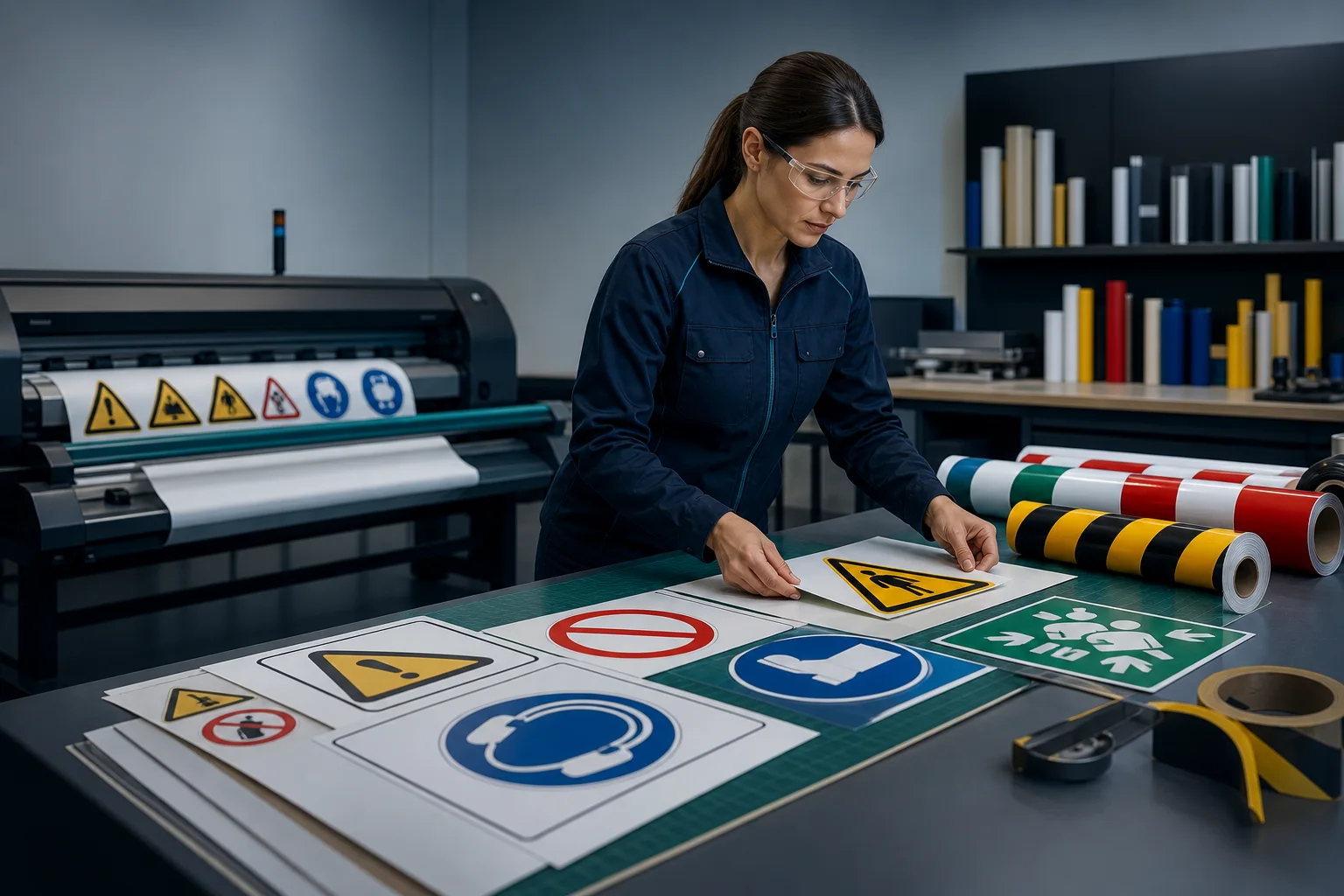
A safety sign is not decoration. It is a workplace control whose colour and shape form an internationally recognised visual code. A missing escape sign or machinery warning can delay the opening of a facility, result in enforcement action and become a serious liability issue after an incident. This guide explains the main sign families, the Hungarian regulatory context and how we produce standard or custom sign packages at short notice.
The essentials in thirty seconds
- In Hungary, workplace safety signs are governed by Decree 2/1998 (I. 16.) MüM; standardised symbols are set out in MSZ EN ISO 7010. Colour and shape work together.
- Red indicates prohibition and fire equipment; yellow warns; blue gives a mandatory instruction; green identifies safe conditions, escape and first aid.
- Hungary’s National Fire Protection Regulations (OTSZ) include additional requirements for fire and escape marking, including visibility when normal lighting fails.
- We produce signs from A8 to A1 in rigid plastic, metal and UV- and weather-resistant self-adhesive materials, including custom shapes and dimensions.
- Common standard signs are available promptly from stock; custom signs can be produced rapidly, including volume requirements.
🟥 Red: prohibition and fire-safety signs
Red performs two distinct jobs. A circular sign with a diagonal bar prohibits behaviour, such as smoking, using a naked flame or entering an area. A red square or rectangle identifies fire-fighting equipment. Under Hungarian OTSZ rules, equipment must be appropriately marked and remain accessible.
Typical red signs cover no smoking, no naked flames, no unauthorised access, no parking and do not extinguish with water. Fire-safety signs identify extinguishers, hose reels, manual call points, fire main switches and fire compartment boundaries. We can also arrange fire-extinguisher servicing.
🟨 Yellow: warning of a hazard
A yellow triangle with a black border neither prohibits nor instructs. It warns that a real hazard exists. Place it before the hazard, where it can be seen in time, and use it only as part of the controls identified by the risk assessment.
Rotating and moving machinery is a particularly important application. Drawing attention to entanglement, shearing and crushing points supports — but never replaces — guarding, isolation and safe systems of work. Solar installations also require correctly located electrical and isolation labels so emergency responders can identify DC and AC equipment safely.
🟦 Blue: mandatory actions
A blue circle identifies required behaviour, including the use of specified PPE. A sign and the workplace must agree: where PPE is mandatory, the employer must provide suitable equipment. See our full PPE catalogue.
Other common mandatory signs specify gloves, protective footwear, fall protection, hand washing or designated pedestrian routes.
🟩 Green: escape, first aid and visibility after lighting failure
A green square or rectangle identifies a safe condition: the escape direction, first-aid point or assembly point. Hungarian OTSZ rules require escape-route safety signs to remain appropriately visible if normal lighting fails. Depending on the design, this may be achieved with photoluminescent material or an illuminated sign, positioned so that the next direction sign is visible along the route.
🏢 Building and facility signs: the pre-opening review
A new residential building, shop, school or industrial site commonly needs a coordinated package:
- Building services: gas and water shut-off points, fire main switch, floor and level numbers, and lift instructions.
- Smoking controls: designated smoking locations and prohibition signs at required entrances and areas.
- Property and traffic: keep-clear access, private property, CCTV, construction-site access and delivery instructions.
- Machinery and workplaces: operating-instruction boards, hazard-zone markings and floor markings.
Tell us what is opening or being built — a shop, residential block, factory or school — and we can assemble the proposed sign package alongside your PPE requirement. Request a quote for safety-sign and label production.
📐 Materials, sizes and finishes
- Size: A8 to A1, from small switchgear labels to large access signs, including custom dimensions and shapes.
- Rigid plastic: a light, economical choice for indoor and sheltered outdoor use.
- Metal: suited to industrial locations, long-term outdoor use and greater mechanical exposure.
- UV- and weather-resistant self-adhesive material: for machinery, doors, glass and vehicles.
- Photoluminescent finish: for escape and fire-safety applications where the design requires continued visibility.
📍 Positioning: a sign must be seen in time
- Place the sign close to the hazard or equipment, at a suitable viewing height and without obstruction.
- Escape signs form a continuous chain; route changes and corridor turns are critical points.
- Select size by viewing distance. Longer recognition distances require larger signs.
- A damaged, faded or illegible sign cannot fulfil its purpose; sign condition belongs in routine workplace inspections.
❓ Frequently asked questions
Which signs are compulsory in a new shop or residential building?
The typical package includes escape direction, fire-extinguisher and hose-reel identification, smoking controls, main isolation points and lift instructions. Industrial premises also need machinery and PPE signs. The definitive scope comes from the building’s fire-safety documentation, risk assessment and the law applying at that location.
When is a photoluminescent sign required?
Hungarian OTSZ rules require relevant escape and fire-safety information to remain visible under specified emergency conditions. The correct solution may be photoluminescent or internally illuminated and must follow the fire-safety design. Requirements differ outside Hungary.
Which material should I choose outdoors?
For durable outdoor use, metal or a UV- and weather-resistant adhesive material is generally appropriate. The substrate, exposure, expected service life and mounting surface decide the final specification.
How quickly can an order be produced?
Common standard signs are supplied promptly from stock. Custom sizes, shapes and wording are produced to an agreed lead time and, where artwork and capacity allow, urgent work can sometimes be completed on the same day. Tell us the opening or inspection date when requesting the quotation so that we can confirm a realistic schedule.
Can you produce custom wording and company branding?
Yes. We produce custom wording, logo, shape and size in-house, while keeping mandatory safety information distinct and legible. We can also coordinate this with branded workwear; see our branded-workwear guide.
Final thought
A good safety sign communicates in seconds, every hour of the day. It only works when the symbol, colour, size, material and position suit the requirement and the workplace.
Tell us what you operate, open or build, and we will help assemble the sign and label package. Request a sign-production quote, or include the signs in a combined PPE quote request.
Professional references for Hungary: Decree 2/1998 (I. 16.) MüM on workplace safety and health signs, MSZ EN ISO 7010, and Decree 54/2014 (XII. 5.) BM, known as OTSZ. The diagrams are simplified illustrations, not standard signs. Produced signs use the appropriate registered symbols. This article does not replace the fire-safety design, risk assessment or requirements applying outside Hungary.