
Safety footwear selection guide
Choose safety footwear by workplace risk, protection class, toe cap, midsole, outsole, slip performance and long-shift comfort.
Guide to selecting safety footwear
Effective workplace protection starts with the right safety footwear
Construction sites, production lines, industrial facilities and warehouses all present hazards to the feet and lower limbs. Heavy objects, sharp items, chemicals and slippery surfaces are only some of the risks. Suitable safety footwear should provide the protection required by the task while remaining comfortable and stable throughout the working day.
Choosing footwear: define the required protection level accurately
S1 category: basic protection
S1 safety footwear provides a practical baseline for dry logistics and light-industrial environments. It includes a protective steel or composite toe cap and normally has a closed heel, antistatic properties and energy absorption in the heel area. Leather or textile uppers can support lower weight and ventilation for extended wear.
S1P category: toe protection with resistance to penetration
S1P footwear combines the S1 properties with a penetration-resistant insert, which may be metallic or non-metallic. It is a useful starting point where sharp objects underfoot are an identified risk, for example on some construction or waste-handling sites. Under EN ISO 20345:2022, non-metallic inserts may carry the PL or PS designation depending on the test nail used.
S3, S3S and S3L categories: wider protection for demanding and wet conditions
S3-class footwear combines toe protection and penetration resistance with requirements for water penetration and absorption of the upper, as well as a cleated outsole. S3L and S3S distinguish the test applied to a non-metallic penetration-resistant insert under EN ISO 20345:2022. These classes are frequently considered for construction, manufacturing and other work where moisture, uneven surfaces and underfoot hazards occur together. They are not a substitute for checking the actual risk assessment and product documentation.
SR: slip resistance
Under EN ISO 20345:2022, the basic slip test is part of the standard and the optional SR marking indicates performance in the additional test condition. Older certificates may instead show SRA, SRB or SRC. Slip performance should always be matched to the actual floor, contamination and cleaning regime; no footwear is universally “non-slip”.
ESD: electrostatic discharge control
ESD footwear is designed to help control electrostatic charge within a verified ESD-protected system. It may be required in electronics manufacture and other electrostatic-sensitive processes. ESD performance is not the same as electrical insulation: footwear for electrical work requires separate, task-specific selection and certification.
SR and ESD markings describe different performance characteristics. Neither should be selected as a general quality badge. State the actual floor condition, electrostatic-control requirement and other hazards in the specification, then verify the declaration of conformity and user instructions for the proposed model.
Protective features and selection points
When specifying safety footwear, consider at least the following:
- Toe protection: a steel or composite toe cap protects against impact and compression to the level declared for the footwear.
- Penetration resistance: select the insert and test designation where sharp objects underfoot are a credible hazard.
- Water-related performance: distinguish water penetration and absorption of the upper from whole-footwear water resistance, and match the requirement to exposure duration.
- Slip performance: assess the floor material and likely contamination, not only the code on the product.
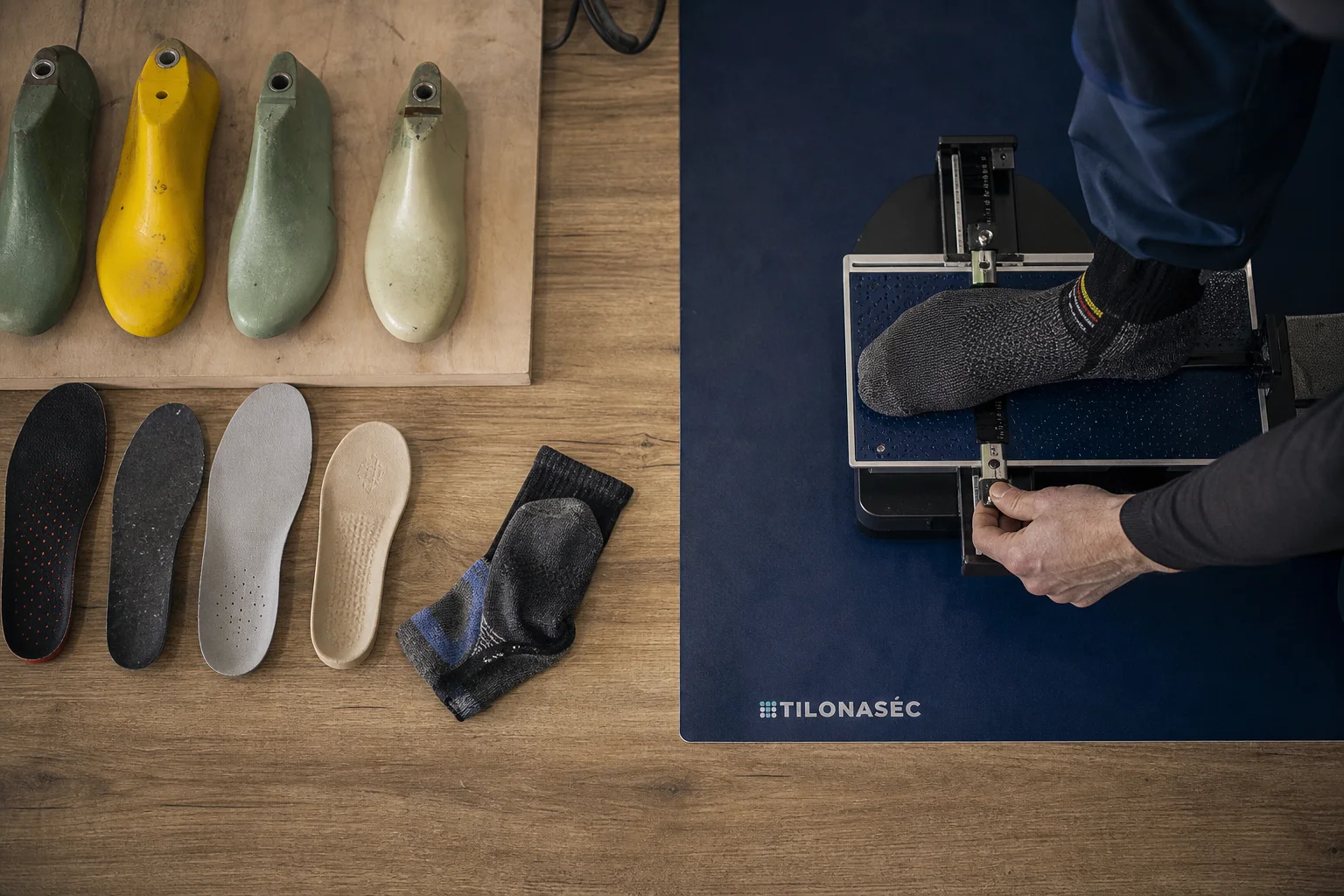
- Fit and wearability: check width, instep, heel hold, sock system and any orthopaedic constraints across a full shift.
Safety and comfort are connected. A model that causes pressure points or instability is less likely to be worn correctly and can create musculoskeletal complaints over time. Run a size and wearer trial before a volume order, and include condition-based replacement rather than relying only on a fixed calendar interval.
Browse our catalogue to compare S1, S1P, S3, S3L and S3S models, or request a quotation with the roles, working conditions, quantities and size distribution. We can help turn those inputs into a clear, comparable footwear specification.
Professional reference point: EN ISO 20345:2022. Selection must follow the workplace risk assessment, the current certificate and the manufacturer's instructions. This guide is general information and does not replace competent occupational safety advice.