
Workplace safety training and PPE: what Hungarian law requires
When workplace safety training is required in Hungary, what practical PPE instruction should cover, and how employers should document it.
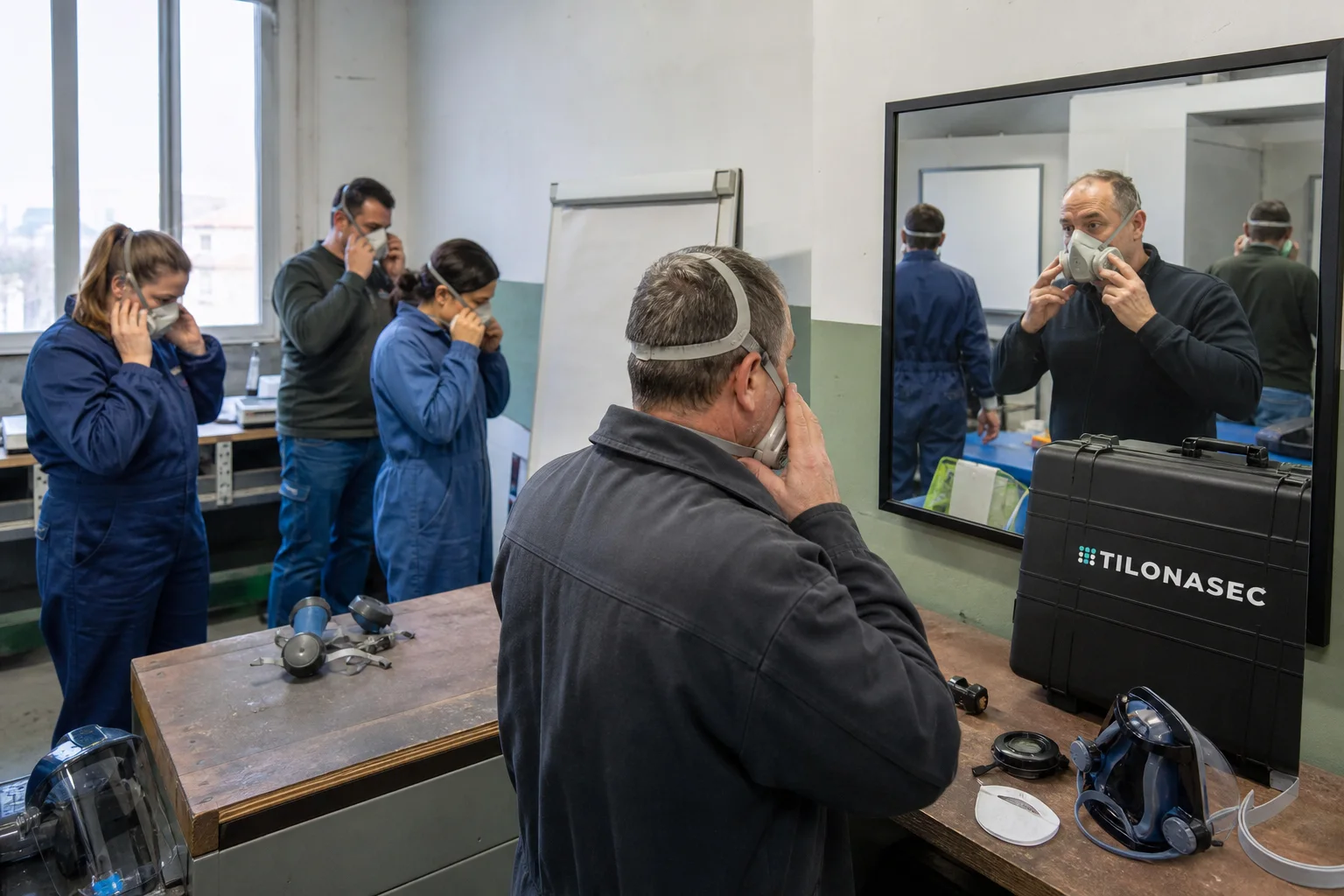
PPE is only as effective as the wearer’s understanding: a poorly adjusted harness, incorrectly fitted respirator or never-cleaned visor may satisfy a paper issue record while leaving a real risk. Training is therefore not an administrative afterthought but the point at which purchased equipment begins to function as intended. This guide summarises the Hungarian training duties and the practical content a PPE session should include.
The essentials in thirty seconds
- Hungarian law requires workplace safety instruction when employment starts, when the role or workplace changes and when new work equipment or technology is introduced, with refresher instruction as needed.
- PPE instruction must be practical: fitting, limitations, care, storage and replacement signs, based on manufacturer information.
- Without suitable documentation, the employer may be unable to demonstrate that instruction took place.
- Introducing new PPE without instruction is incomplete; a wearer trial and training work best together.
- We can support the equipment we supply with practical use demonstrations and workplace safety training arrangements.
📚 When is training required in Hungary?
| Situation | Why it matters | PPE focus |
|---|---|---|
| Starting work | A new employee does not know local hazards and arrangements | Correct use of the complete issued set from day one |
| Changing role or workplace | Hazards and equipment may change | Instruction on newly required PPE |
| Introducing equipment or technology | Established routines may no longer apply | A new PPE type needs specific practical instruction |
| Refresher instruction | Knowledge fades and shortcuts develop | Refresh fitting, limitations and replacement signs |
🧤 What should PPE instruction cover?
- What it protects against — and what it does not: a cut-resistant glove is not protection from a moving circular saw, and FFP2 does not filter gases.
- Correct donning and fitting: seal checks for respirators, buckle adjustment for a harness and cradle adjustment for a helmet, demonstrated with the actual product.
- Care and storage: what can be washed, how it should be cleaned and what may damage it.
- Replacement signs: wear, damage, a depleted coating or a life limit, plus a clear route for requesting a replacement.
- Manufacturer information: the authoritative product-specific source. Our documentation guide explains how to keep it accessible.
✍️ Documentation: demonstrating what happened
Under Hungarian arrangements, the employer should be able to show who received instruction, when, on what subjects and with what acknowledgement or assessment. A practical record combines a concise equipment-specific syllabus, attendance evidence and the issue record. This becomes important during audit and incident investigation. Organisations outside Hungary should use the documentation required by their national system.
💡 Making training effective
- Keep it short and product-specific: three focused twenty-minute hands-on sessions can be more useful than one two-hour presentation.
- Connect it to implementation: participants in the wear trial can become the first trained users and reinforce good practice on shift.
- Check practical ability: do not merely describe a respirator seal check; ask each wearer to perform it.
- Refresh for a reason: repeated misuse, complaints or incident trends may show a training need rather than a product defect.
If internal capacity is limited, review our PPE supply and training service or request a quote. We can coordinate product supply with practical instruction.
❓ Frequently asked questions
Who may deliver workplace safety training?
In Hungary, the professional basis of general workplace safety training must be provided through a suitably qualified workplace safety professional. Product-specific practical demonstrations can also involve a knowledgeable supplier specialist working from manufacturer instructions. The legal and product elements should be coordinated.
How often should it be repeated?
Hungarian law links refreshers to need and change; internal arrangements commonly set a regular cycle as well. A new product, process or role requires prompt instruction. Observed misuse is also a reason to act regardless of the calendar.
Is e-learning enough?
It can support theory, but PPE depends on practical fitting, adjustment and checking. A screen-only course should not replace hands-on competence where the product requires it.
What does this have to do with procurement?
Training protects the return on the purchased equipment: incorrect use reduces protection and can shorten service life. Supplier capability to support implementation is therefore a legitimate procurement criterion.
Final thought
Training is where issued PPE becomes real protection: concise, practical, product-specific and documented. Planning procurement and instruction together helps the equipment reach not only the storeroom, but the wearer in a usable form.
Request a quote that includes practical instruction, browse the catalogue, or read about our PPE supply and training service.
Professional references: Hungary’s Act XCIII of 1993 on Occupational Safety and manufacturer information supplied under EU Regulation 2016/425. This is general guidance; a competent workplace safety professional must establish the training programme for the specific workplace and jurisdiction.