
Workplace first aid: legal duties and what to keep in the cabinet
A practical guide to the equipment, trained personnel and arrangements required for workplace first aid, including placement, replenishment and inspection.
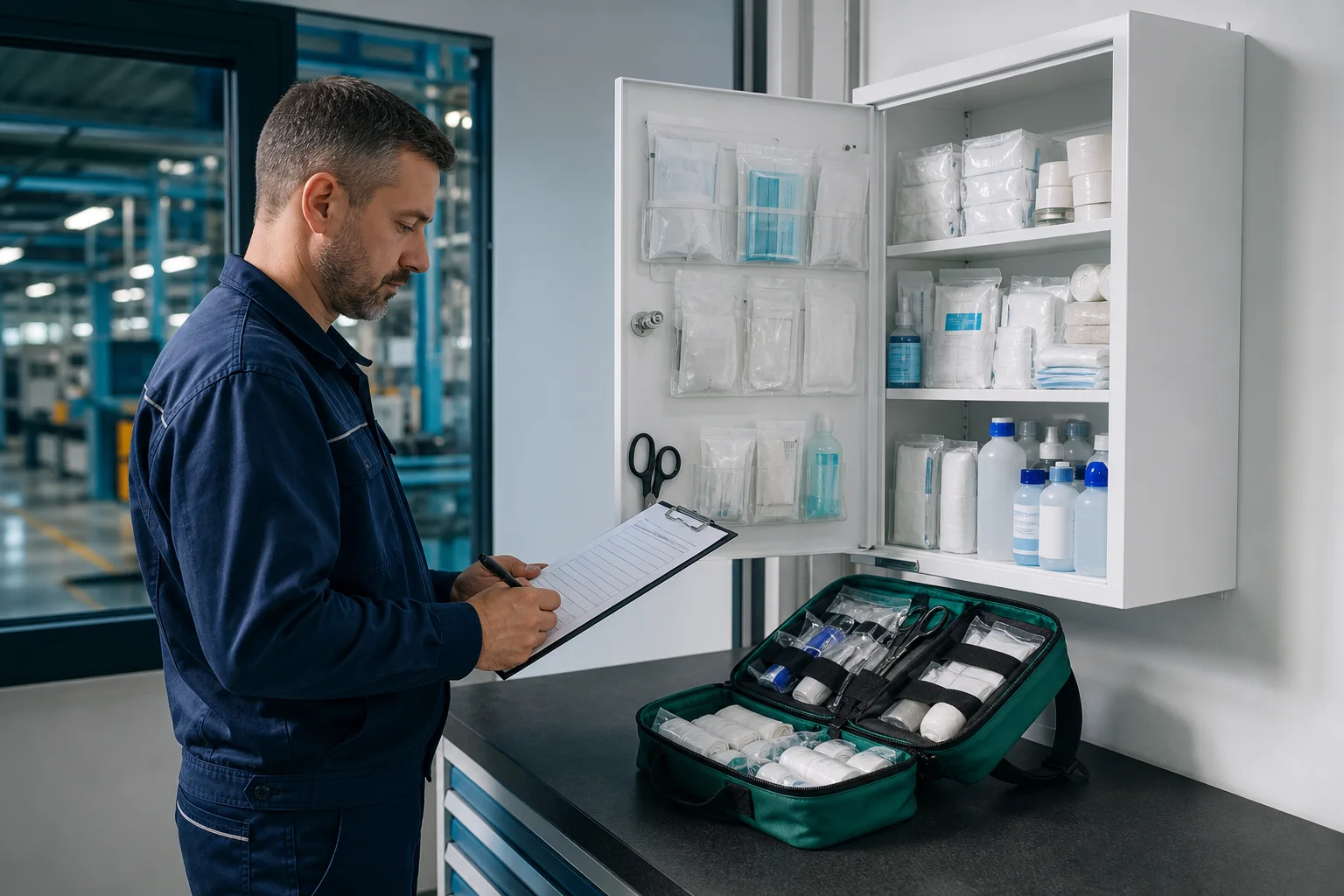
A first-aid kit is often ignored until it is needed — when someone discovers that dressings have expired, the scissors are missing and the cabinet is on the furthest shelf in the warehouse. This guide explains the Hungarian requirements for workplace first-aid provision, what suitable equipment may contain and how to maintain a system that works in an emergency.
The essentials in thirty seconds
- Under Hungarian workplace safety law, the employer must provide the equipment, trained people and organisational arrangements needed for first aid.
- There is no single universal contents list. Provision must reflect the workplace, hazards, number of employees and advice from the occupational health service.
- Equipment only helps when it is readily accessible: clearly signed, close to the work area and not locked behind an unavailable key.
- Expiry control is a common failure. Sterile dressings and disinfectants expire, and used items must be replaced.
- Where chemicals can splash, eyewash provision requires separate consideration; a first-aid box alone may not be sufficient.
📋 What does Hungarian law require?
Hungary’s Act XCIII of 1993 on Occupational Safety requires workplace first-aid equipment, personnel and organisational conditions to be provided with regard to the workplace’s nature and location, its hazards, workforce and organisation of work.
In practice, this creates three related requirements:
- Equipment: the kit, cabinet or bag and the contents appropriate to the identified risks.
- People: designated, suitably trained first aiders available while work is taking place.
- Organisation: employees know where the equipment is, whom to contact and how to raise the alarm.
Hungarian legislation does not prescribe one fixed quantity for every workplace. Determine the contents from the risk assessment in consultation with the occupational health service. International employers should also check the rules applying in the country where the workplace operates.
🧰 What should the provision contain?
Contents vary by workplace, but the following groups provide a practical starting point for the professional assessment:
| Group | Typical items | What to check |
|---|---|---|
| Wound care | Sterile gauze, wound dressings, conforming bandage, plasters and triangular bandage | Sterility and expiry; opened sterile packs must not be returned |
| Equipment | Trauma shears, tweezers, adhesive tape and safety pins | Trauma shears must be suitable for cutting clothing |
| Responder protection | Single-use gloves and a resuscitation face shield or mask | The first aider’s protection is part of the provision |
| Additional items | Emergency blanket, suitable disinfectant, eyewash and waste bags | Check expiry and storage instructions |
| Records | Contents list, incident record and emergency numbers | Keep information current and legible |
Medicines should generally not be placed in a workplace first-aid kit. Administering medication is not an ordinary first-aid task and creates clinical and liability questions.
📍 Where should it be kept and how should it be signed?
First-aid equipment must be reachable within minutes. In practical terms:
- Keep it close to the work; a large or divided site may require several points rather than one central cabinet.
- Avoid a conventional lock, or use an emergency-access arrangement. A key held by an absent person makes the kit unusable.
- Sign it clearly: the white cross on green is internationally recognisable. See our guide to safety signs for marking and escape-route considerations.
👁️ Eyewash requires its own assessment
Where work involves chemicals, dust or splashes, eyewash is not a minor accessory to the first-aid box. Two common levels are:
- Portable eyewash bottles with suitable solution for immediate initial irrigation. They have an expiry date and normally require replacement once opened.
- Plumbed eyewash or an emergency shower where corrosive substances are used. Routine activation or flushing forms part of maintenance.
The safety data sheet gives substance-specific first-aid instructions, including irrigation duration. These instructions can differ significantly between materials.
🔄 Maintenance: where provision most often fails
First-aid equipment is not a one-off purchase. Four habits keep it ready:
- Replace used items immediately. Do not leave a partly depleted kit until the next scheduled check.
- Record expiry dates. Place the earliest expiry date on an inspection label or digital schedule.
- Inspect at a defined interval, commonly quarterly or half-yearly according to local arrangements, with a named responsible person and a record.
- Review after operational change. New machinery, a new chemical, revised shift patterns or a larger workforce may make previous provision inadequate.
Frequently asked questions
How many first-aid kits do we need?
There is no one number suitable for every workplace. Consider headcount, site size and layout, risk level and the time needed to reach the equipment. A multi-building plant usually needs several distributed points. In Hungary, the occupational health service’s advice is an important part of the final decision.
Who can be a workplace first aider?
A designated employee with suitable training for the workplace arrangements. Training and workplace safety instruction must be documented and refreshed. See our workplace safety training guide.
Is having a box enough?
No. Hungarian law addresses equipment, trained people and organisational arrangements. A box without an available first aider is deficient, as is a trained first aider without suitable equipment.
Final thought
Buying a first-aid kit is straightforward; keeping it complete, in date and accessible for years is the real task. A named owner and an expiry schedule are worth more than an expensive cabinet that nobody checks.
Send us the workforce size, activities and key hazards in a quote request. We can assemble suitable equipment and refill packs, or you can browse our first-aid and workplace safety range.
Professional reference: Hungary’s Act XCIII of 1993 on Occupational Safety requires the equipment, personnel and organisational arrangements for workplace first aid. The specific content and quantity must be determined by the risk assessment and occupational health advice. This guide does not replace that assessment or the rules applicable outside Hungary.