
PPE tender documents: a specification template using EN standards
Write a PPE specification that produces comparable bids: five layers of requirements, a role-based template and practical evaluation criteria.
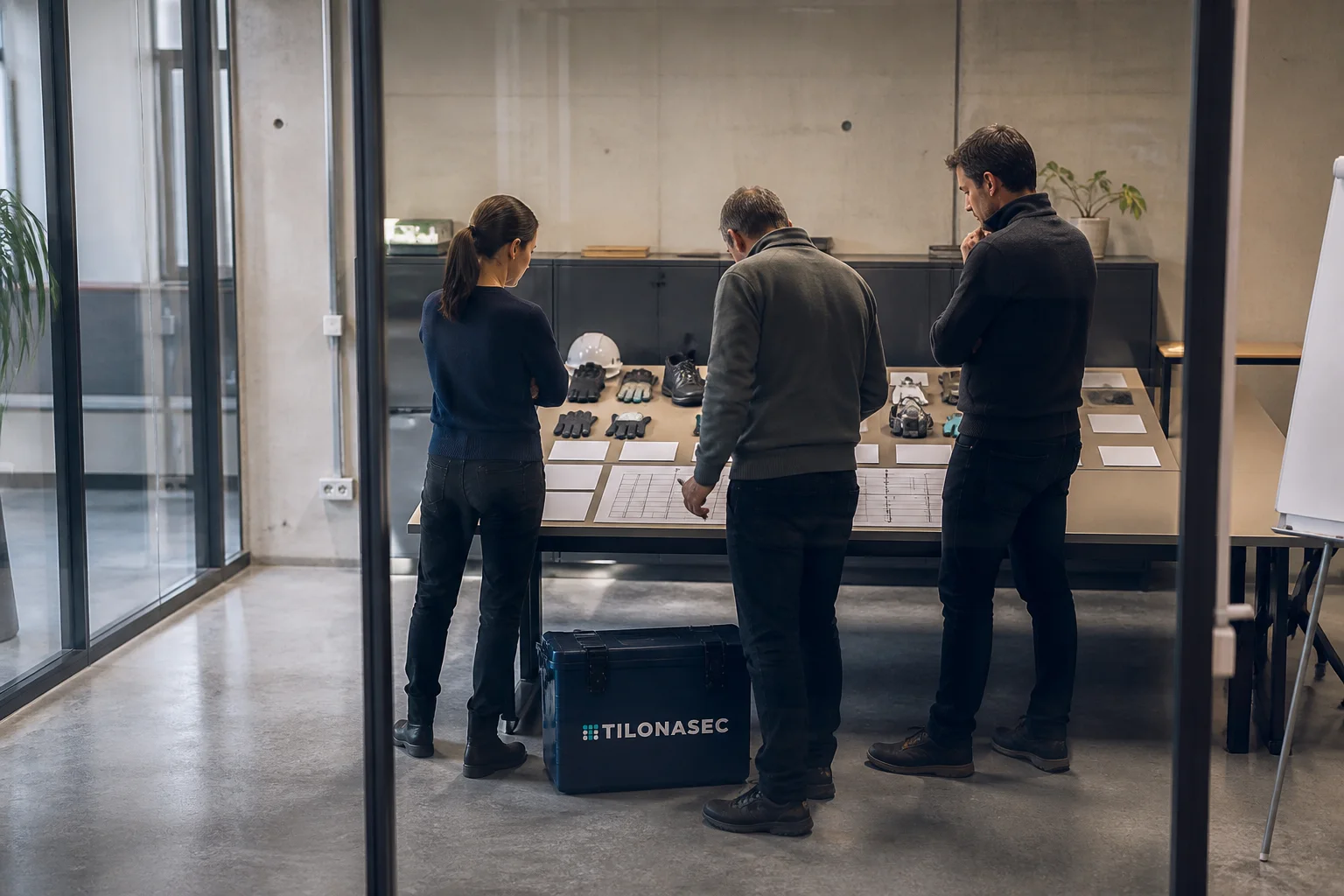
The quality of the tender determines the quality of the bids. A vague brief tends to reward the lowest price; a sound brief identifies the most suitable offer. In PPE procurement this is not a minor distinction. Employees' safety bears the cost of an incorrectly specified product. This guide explains how to write a brief that produces comparable, technically credible bids, including a model specification.
The essentials in 30 seconds
- A brief such as “500 pairs of safety gloves” produces offers that cannot be compared and makes price the default deciding factor.
- A robust specification has five layers: hazard, EN standard and performance level, comfort, logistics and documentation.
- Evaluation should give weight to service life, sample trials and continuity of supply, not just unit price.
- A supplier should be a technical partner, not merely a courier. Expect assessment, size trials and informed advice.
- The table below provides a reusable model specification for common job roles.
🎯 Anatomy of a weak brief
A typical weak request reads: “Please quote for 500 pairs of safety gloves and 40 pairs of safety boots.” One bidder may offer an EN 388 4544C cut-resistant glove and another a basic coated cotton glove. Both can be described as safety gloves, but their prices and capabilities are fundamentally different.
The bids are not comparable, so price becomes the only common measure and the least capable product may win. Employees receive uncomfortable or under-specified PPE and complaints become another criterion in the next tender. A proper specification breaks this cycle.
📐 The five layers of a sound specification
- Hazard: what does the employee do, with what materials and in which environment? The answer comes from the risk assessment.
- Standard and performance level: the EN code and level linked to the risk, such as an EN 388 cut level or EN ISO 20345 class. This makes bids comparable.
- Comfort and compatibility: complete size range, ventilation and compatibility with other PPE. Uncomfortable PPE is removed, and removed PPE cannot protect.
- Logistics: replacement cycle, pack size, replenishment lead time and stock security.
- Documentation: EU declaration of conformity, data sheet and standard edition. Without records, claimed protection cannot be demonstrated.
📋 Model specification for common roles
This is a starting point. The site-specific risk assessment must determine the exact requirement; we can assist with that process:
| Role | Typical hazard | Requirement in the brief | Additional points |
|---|---|---|---|
| Assembly or precision work | Abrasion, minor injury | EN 388, coated precision glove, suitable tactility | Breathable construction for full-shift wear |
| Sheet-metal work or glass handling | Cut | EN 388, ISO 13997 cut level C–D | Use the A–F letter rating rather than the former coupe-test digit |
| Warehouse and logistics | Falling objects, puncture | EN ISO 20345 S1P footwear, often with an ESD requirement | Complete size range and suitable comfort insole |
| Construction site | Moisture, puncture, falling objects | EN ISO 20345 S3 footwear and EN 397 helmet | Recognise 2022 classifications, including S3L and S3S |
| Welder | Flame, molten-metal spatter, radiation | EN ISO 11611, Class 2 where required, and EN 175 face protection | Non-melting base layer beneath the garment |
| Work at height | Fall from height | EN 361 harness and connecting system suited to working height and clearance | Plan periodic examination as part of procurement |
Our technical guides explain the markings: protective gloves, safety footwear, safety helmets and the 2022 footwear-standard changes.
Send us the job roles in a request for quotation and we can structure the requirement and propose products matched to the risks.
⚖️ Evaluation: price is only one criterion
- Compliance: is the required EN performance documented? Treat this as pass/fail.
- Sample-trial result: feedback from actual users. See our wearer-trial guide.
- Total cost: expected service life and replacement frequency, not unit price. See quality PPE procurement.
- Continuity of supply: stock availability, replenishment time and call-off arrangements.
- Technical support: assessment, sizing sessions and training materials.
🤝 What should you expect from the supplier?
- On-site or remote assessment based on tasks and hazards rather than catalogue browsing.
- Samples and a size trial before the decision.
- Standards knowledge: we have worked in occupational safety for more than three decades and translate changes into practical procurement requirements.
- Related services from one source: garment branding, extinguisher maintenance and fall-protection inspections.
- Two stores with stock, in Szeged and Budapest, to support samples, size exchanges and urgent replacement.
❓ Frequently asked questions
What if the bids differ only in price?
This usually indicates a gap in the brief. Add EN performance codes and require samples; the technical differences will become visible.
Can I request samples before deciding?
You can and should. A wearer trial is the least expensive way to confirm that a product which is suitable on paper also works in practice. We actively recommend it and provide samples.
How long is an EU declaration of conformity valid?
The declaration relates to the product and its conformity-assessment basis. Check that the cited standard and edition meet the brief and that the document applies to the precise model. For Category II or III PPE, request the type-examination details if clarification is needed.
How long should the contract run?
For consumables, a 12-month framework with call-offs is often predictable. For durable equipment, align deliveries with seasons and replacement cycles. Our annual PPE budget guide covers this.
Final consideration
A good tender does not seek the lowest bid; it seeks the most suitable bid, and the brief determines whether that is possible. Specifying EN performance, total cost and wearer trials produces comparable offers, a defensible decision and equipment that employees will use.
Send us the roles and hazards and we can create or review the specification. Request a quotation, or browse our catalogue.
Professional reference points: Regulation (EU) 2016/425, the EN standards cited and Hungary's Act XCIII of 1993 on Occupational Safety. This article provides general guidance and does not replace a workplace risk assessment or the law applicable at the place of use.