
Protective glove selection guide
Protective glove standards and markings explained: mechanical and chemical risks, cut resistance, materials, coatings, grip and sizing.
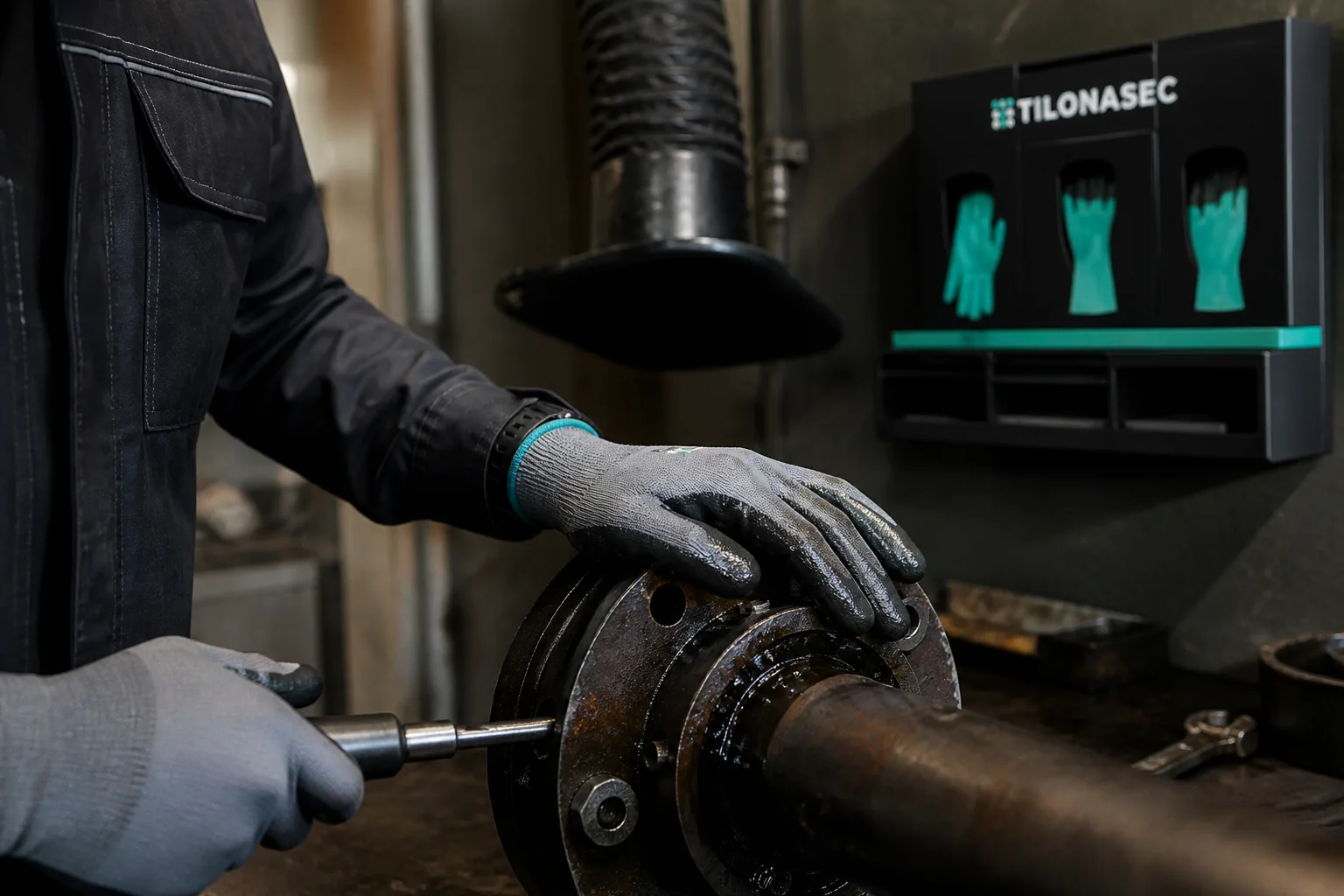
Protective-glove selection: standards, markings and control of hand-injury risks
Hands and arms perform a large share of physical work and are exposed to many workplace hazards. Appropriate gloves can help control cuts, abrasion, puncture, heat, cold, chemicals and other identified risks, but there is no universal “safety glove”. Selection must follow the task, exposure, required dexterity and the other controls defined by the risk assessment.
PPE placed on the European market is governed by Regulation (EU) 2016/425, which entered into force on 21 April 2016 and became fully applicable in April 2018, replacing Directive 89/686/EEC. Check the current EU declaration of conformity and manufacturer instructions for the exact glove.
EN 420:2003+A1:2010 — general requirements for protective gloves
EN 420 defined general requirements for glove design, construction, sizing, dexterity, harmlessness, marking and information. It has since been superseded by EN ISO 21420, so procurement specifications should state the current standard unless an older, valid product certificate is being reviewed.
Three PPE risk categories
Regulation (EU) 2016/425 groups PPE, including protective gloves, into three risk categories:
Category I
Simple PPE for minimal risks that the user can identify and assess in time. The manufacturer is responsible for conformity assessment and documentation. Category I should not be treated as suitable for any hazard merely because the task appears routine.
Category II
PPE for risks that are neither Category I nor Category III. Many gloves for mechanical risks, including abrasion, cut, tear and puncture performance, fall within this category. EU type examination by a notified body is required.
Category III
Complex PPE for risks that may cause very serious consequences, including death or irreversible damage to health. Examples may include certain chemical, thermal and electrical risks. In addition to EU type examination, production is subject to ongoing conformity-assessment surveillance. The four-digit number of the notified body responsible for that surveillance appears after the CE marking.
EN 388:2016
PROTECTIVE GLOVES AGAINST MECHANICAL RISKS
Developments in high-performance fibres made the earlier EN 388:2003 rotating-blade method less reliable for some cut-resistant materials, particularly those that blunt the blade. EN 388:2016 revised abrasion and cut testing and added the ISO 13997 straight-blade cut test and an optional impact-protection assessment.
The EN ISO 13997 method uses different applied forces to determine the force at which a straight blade cuts through the specimen over a 20 mm travel. The result is expressed in newtons and classified from A to F.
- Impact protection — marking P where the applicable 5 J test is passed
- ISO 13997 straight-blade cut resistance — level A–F
- Abrasion resistance — level 1–4
- Coupe blade-cut resistance — level 1–5
- Tear resistance — level 1–4
- Puncture resistance — level 1–4
EN 388:2016 / ISO 13997 test method
- The straight-blade method is particularly relevant where the glove material, for example glass or steel fibre, can blunt the circular blade.
- A sharp straight blade contacts the material once under a controlled force.
- The test determines the minimum force required to cut through over a 20 mm blade travel.
- The result in newtons determines the A–F cut-performance level.
The earlier EN 388:2003 method classified mechanical performance beside the shield pictogram. It covered abrasion, coupe cut, tear and puncture. Although older valid certificates may still be encountered, new specifications should use the current edition and interpret every position of the marking rather than quoting a single “cut level”.
- Abrasion resistance: the material is abraded under defined pressure and the number of cycles to breakthrough is recorded. The former highest level was 4 at 8,000 cycles.
- Coupe blade-cut resistance: a rotating circular blade repeatedly crosses the material and the result is compared with a reference fabric. The former highest level was 5 at index 20.
- Tear resistance: the force required to continue tearing a prepared specimen is measured. The former highest level was 4 at 75 N.
- Puncture resistance: the force required for a standard stylus to penetrate the material is measured. The former highest level was 4 at 150 N. This is not a hypodermic-needle test.
| EN 388 | Level 1 | Level 2 | Level 3 | Level 4 | Level 5 |
|---|---|---|---|---|---|
| Abrasion resistance, cycles | 100 | 500 | 2,000 | 8,000 | – |
| Coupe blade-cut resistance, index | 1.2 | 2.5 | 5 | 10 | 20 |
| Tear force, N | 10 | 25 | 50 | 75 | – |
| Puncture force, N | 20 | 60 | 100 | 150 | – |
| EN ISO 13997:1999 TDM | Level A | Level B | Level C | Level D | Level E | Level F |
|---|---|---|---|---|---|---|
| Cut-test force, N | 2 | 5 | 10 | 15 | 22 | 30 |
EN 407:2004
PROTECTIVE GLOVES AGAINST THERMAL RISKS — HEAT AND/OR FIRE
EN 407 specifies test methods, general requirements, performance levels and markings for gloves protecting against heat and/or fire. The pictogram is followed by six performance positions:
- Limited flame spread, 0–4
- Contact heat, 0–4
- Convective heat, 0–4
- Radiant heat, 0–4
- Small splashes of molten metal, 0–4
- Large quantities of molten metal, 0–4
Contact-heat performance is assessed for a threshold time of 15 seconds:
| Performance level | Contact temperature | Threshold time |
|---|---|---|
| 1 | 100°C | ≥15 s |
| 2 | 250°C | ≥15 s |
| 3 | 350°C | ≥15 s |
| 4 | 500°C | ≥15 s |
EN 407 gloves can be tested for contact, convective and radiant heat and for molten-metal splash. The standard does not by itself qualify a glove for every specialist use, such as firefighting or welding, which have additional product standards and task requirements.
- Limited flame spread: the glove is exposed to a gas flame for 15 seconds and after-flame and after-glow times are measured. The source describes the highest performance as Level 4, with 2 seconds after-flame and 5 seconds after-glow.
- Contact heat: the highest temperature between 100°C and 500°C at which the inside rises by no more than 10°C within 15 seconds is measured. Level 4 corresponds to +500°C under the test conditions.
- Convective heat: the time for the inner temperature to rise by 24°C under heat from a flame is measured; the highest level is 4.
- Radiant heat: the time for a defined heat quantity to pass through the glove is measured; the source gives Level 4 as at least 150 seconds.
- Small molten-metal splashes: the number of droplets needed to raise the temperature between the glove and simulated skin by 40°C is measured; the source gives Level 4 as more than 35 droplets.
- Large molten-metal quantities: the mass of molten iron required to damage PVC simulated skin inside the glove is measured; the source gives Level 4 as 200 grams.
EN 12477:2001
PROTECTIVE GLOVES FOR WELDERS
This standard specifies requirements and tests for gloves used in manual metal welding, cutting and related processes. Welding gloves are divided into two types:
Type A: lower dexterity with higher performance in other specified properties.
Type B: higher dexterity with lower performance in some other specified properties.
EN 511:2006
PROTECTIVE GLOVES AGAINST COLD
EN 511 specifies requirements and tests for gloves protecting against convective and contact cold down to -50°C. The cold may arise from weather or an industrial process. Test levels describe performance under standard conditions and must be interpreted for the actual exposure, activity and moisture.
- Resistance to convective cold, 1–4
- Resistance to contact cold, 1–4
- Water penetration, 0–1
For convective cold, the energy needed to maintain a heated artificial hand at 30–35°C in a controlled environment is used to calculate insulation. For contact cold, tested in accordance with ISO 5085 in the source material, thermal resistance is determined with the glove material between a warm and a cold plate.
Water penetration can additionally be assessed. In the cited method, a glove that remains free from water ingress for 30 minutes passes the test; there are no graded performance levels.
EN ISO 10819:1996
GLOVES — VIBRATION TRANSMISSION
This standard defines laboratory measurement, analysis and reporting of vibration transmission through gloves over the frequency range 31.5 Hz to 1,250 Hz. An “anti-vibration” glove does not remove the need to control tool vibration and exposure time at source.
EN 1149-1:2006
Protective clothing — electrostatic properties — Part 1: surface resistivity, test method and requirements.
The method concerns electrostatic-dissipative materials intended to reduce incendive discharge. It is not a test for protection against high voltage or mains electricity.
EN 1149-5:2008
Protective clothing — electrostatic properties — Part 5: material performance and design requirements.
The standard sets requirements for electrostatic-dissipative protective clothing used as part of a complete earthed system. It does not provide protection against mains voltage and may not cover every oxygen-enriched or highly flammable atmosphere.
ESD — ELECTROSTATIC DISCHARGE
EN 16350:2014 — PROTECTIVE GLOVES: ELECTROSTATIC PROPERTIES
EN 16350 specifies test conditions and minimum requirements for electrostatic properties of protective gloves intended for potentially explosive areas. It requires vertical resistance below 1.0 × 10⁸ ohms, rather than a general claim of “less than 10 ohms”.
- Vertical resistance: Rv < 1.0 × 10⁸ Ω.
- Test environment: 23 ± 1°C and 25 ± 5% relative humidity.
Important: an electrostatic-dissipative glove is effective only within a verified earthing chain that includes the wearer, clothing, footwear and floor. It is not electrically insulating PPE.
Earlier classification based only on surface resistance under EN 1149-1 does not demonstrate vertical charge dissipation through the glove. EN 16350-certified gloves may form part of the control system in fire- or explosion-hazard areas such as refineries, but only when the complete earthing system and area classification are suitable.
IEC 61340-5-1:2016
PROTECTION OF ELECTRONIC DEVICES FROM ELECTROSTATIC PHENOMENA — GENERAL REQUIREMENTS
This standard addresses electrostatic-control programmes for areas where discharge may damage sensitive components such as printed circuit boards and microchips. Product protection under an ESD-control programme is distinct from worker protection against explosive atmospheres or electric shock.
FOOD-CONTACT SUITABILITY
Regulation (EC) No 1935/2004 establishes general requirements for materials intended to contact food. Under foreseeable conditions of use, their constituents must not transfer to food in quantities that could endanger human health or otherwise breach the Regulation. A generic CE or glove marking does not itself prove suitability for every food, temperature or contact time; check the food-contact declaration.
EN ISO 374-1:2016
PROTECTIVE GLOVES AGAINST DANGEROUS CHEMICALS AND MICRO-ORGANISMS
EN ISO 374-1 substantially revised classification and marking for chemical-protective gloves. Important changes included:
- Expansion of the reference chemical list from 12 to 18 substances.
- Withdrawal of the former low-chemical-protection beaker symbol.
- Classification as Type A, B or C.
- A flask pictogram accompanied by the code letters of the chemicals for which the required permeation level was achieved.
Type A permeation resistance: at least 30 minutes for each of at least 6 test chemicals.
Type B permeation resistance: at least 30 minutes for each of at least 3 test chemicals.
Type C permeation resistance: at least 10 minutes for at least 1 test chemical.
Manufacturer permeation data and instructions remain essential. The risk assessment must identify the exact substance, concentration, mixture, temperature, contact pattern and required wear time. Breakthrough time measured in a laboratory is not the same as a safe in-use replacement interval; degradation, flexing and contamination can shorten practical service life.
The revision also introduced degradation testing under EN 374-4:2013, replaced EN 374-3:2003 with EN 16523-1:2015 for permeation, required gloves longer than 400 mm to be assessed at the cuff and removed the former general requirement to test every chemical glove to EN 388.
| Code | Test chemical | Class |
|---|---|---|
| A | Methanol | Primary alcohol |
| B | Acetone | Ketone |
| C | Acetonitrile | Nitrile compound |
| D | Dichloromethane | Chlorinated paraffin |
| E | Carbon disulphide | Sulphur-containing organic compound |
| F | Toluene | Aromatic hydrocarbon |
| G | Diethylamine | Amine |
| H | Tetrahydrofuran | Heterocyclic ether |
| I | Ethyl acetate | Ester |
| J | n-Heptane | Saturated hydrocarbon |
| K | Sodium hydroxide 40% | Inorganic base |
| L | Sulphuric acid 96% | Inorganic mineral acid |
| M | Nitric acid 65% | Oxidising inorganic mineral acid |
| N | Acetic acid 99% | Organic acid |
| O | Ammonium hydroxide 25% | Inorganic base |
| P | Hydrogen peroxide 30% | Peroxide |
| S | Hydrofluoric acid 40% | Inorganic acid and contact poison |
| T | Formaldehyde 37% | Aldehyde |
EN ISO 374-2:2014
Determination of resistance to penetration. The source notes no major change from EN 374-2:2003.
EN ISO 374-4:2013
Determination of resistance to degradation by chemicals. Puncture resistance is compared before and after chemical exposure and the average change is reported as a percentage in the user information.
EN ISO 374-5:2016
Terminology and performance requirements for protection against micro-organisms. Micro-organisms include bacteria, fungi and viruses. Gloves claiming virus protection must also meet the applicable ISO 16604:2004 test requirement.
EN 16523-1:2015
Determination of material resistance to permeation by liquid chemicals under continuous contact. The source notes that the method is similar to the withdrawn EN 374-3 test. Verify the current standard designation and transition rules on the product certificate.
SINGLE-USE GLOVES
Single-use gloves should be selected for the task, material compatibility, required AQL, food-contact or medical status, and the necessary chemical or biological claims. Products described in the source range carry AQL 1.5, relevant EN certification, are non-sterile and CE marked. These attributes must be verified for each exact model rather than assumed across a whole range.
EN 455:2000
MEDICAL GLOVES FOR SINGLE USE
The EN 455 series addresses single-use medical gloves:
- Requirements and testing for freedom from holes.
- Requirements and testing for physical properties.
- Requirements and testing for biological evaluation.
- Requirements and testing for shelf-life determination.
EN 381-7:1999
GLOVES FOR USERS OF HAND-HELD CHAINSAWS
This standard specifies requirements for protective gloves worn when using a hand-held chainsaw. Resistance is assessed using the test approach referenced from EN 381-4. The manufacturer must state selection and use information. Chainsaw PPE does not eliminate kickback or cutting risk and must accompany trained operation and other controls.
| Class | 0 | 1 | 2 | 3 |
| Maximum chain speed | 16 m/s | 20 m/s | 24 m/s | 28 m/s |
Practical procurement checklist
- Define the substance, mechanical hazard, temperature, duration and required dexterity from the task-level risk assessment.
- Specify the exact EN performance positions rather than requesting a generic “protective glove”.
- Check the EU declaration of conformity, user instructions and, for chemicals, permeation and degradation data for the exact model.
- Run a wearer trial across sizes and shifts; grip and comfort can change materially with contamination and prolonged wear.
- Set replacement, contamination-control and disposal rules before issue.
Browse protective gloves in our catalogue, or request a quotation with the task, hazard, substance details, quantities and sizes. We can help convert these inputs into a technically comparable glove specification.
This article provides general guidance. Standards and legal references should be checked in their current editions, and glove selection must follow the workplace risk assessment and the manufacturer's documentation. For use in Hungary, also apply the relevant Hungarian occupational safety requirements.